Brainwaves by Burak Büyükdemir
Field notes from 26 years of investing in early-stage startups.
May 2, 2026
Why You Should Read Alan Kay's "The Center of Why?"
· · ·
|
Quick Personal Note
I will be in San Francisco this week.
So next week, you should expect fewer emails from me.
But I will share something more personal from SF — some stories, observations, and thoughts from the trip.
Now, back to today's note.
|
I read Alan Kay's "The Center of Why?"
And I think everyone interested in education, technology, startups, creativity, or children should read it.
Not because it is a perfect paper.
Not because it gives a simple framework.
But because it reminds us of something very basic:
Real learning starts with curiosity.
Not curriculum.
Not exams.
Not slides.
Not certificates.
Curiosity.
Mary Quirk's table
Alan Kay tells his own learning story.
As a child, he read many books before school. That gave him one important lesson early: different people explain the same world in different ways.
So he learned not to believe something just because it was written in a book.
Then he went to school. And school had "one book." One official answer. One teacher authority. One version of reality.
That is where the problem begins.
Many schools do not teach children how to think.
They teach children how to repeat.
The best part of the paper is the story of Alan Kay's teacher, Mary Quirk.
She had a table in the classroom. On the table were tools, wires, batteries, gears, books, random objects.
She did not explain everything. She did not control everything. She created an environment where children could discover.
One day Kay built a simple electromagnet. Instead of punishing him for not following the lesson, the teacher asked:
That sentence is the whole philosophy.
A good teacher does not kill the moment of discovery.
A good teacher protects it.
Children are closer to scientists than we think
They do not know yet. Scientists also do not know yet.
Both need to explore. Both need to test. Both need to build their own understanding.
The teacher's job is not to pour information into children. The teacher's job is to design the right environment — a place where children can make the final leap themselves.
This is also about startups
Founders also learn by doing.
Not by reading market reports.
Not by building pitch decks.
Not by listening to generic advice.
They learn by touching reality. Talking to customers. Trying things. Getting rejected. Changing the product. Seeing what breaks. Then trying again.
That is real learning.
We rarely see reality
Another powerful part of the paper is Kay's point about perception.
We think we see reality. But usually, we see our own stories. Our assumptions. Our fears. Our social programming. Our "common sense."
And common sense is often wrong.
Science, art, and technology help us see better. They make the invisible visible.
Education should do the same. Not give more information. But help people see what they were blind to before.
Computing as a medium
Kay also explains computing in a way I love.
The computer is not just a tool. Not just a faster calculator. Not just software.
It is a medium. Like writing. Like music. Like drawing. But more powerful.
Because with computers, children can build models of the world. They can simulate gravity. Create cars. Model epidemics. See complex systems. Test ideas. Turn abstract concepts into something alive.
That is why computing matters. Not because every child should become a programmer — but because every child should learn how to think with powerful tools.
The most important lesson
Learning is not downloading information. Learning is changing how you see.
That is a much bigger goal. And honestly, most schools still miss this.
They give answers before children feel the question. They give formulas before children see the problem. They give exams before children build understanding. They give authority before curiosity.
That is backwards.
What should we do instead?
Create environments where children can ask better questions.
Let them build. Let them test. Let them fail safely. Let them explain what they discovered. Let them connect art, science, math, and technology. Let them stay curious long enough to become real learners.
For founders, investors, educators, parents, and anyone building the future, this paper is worth reading. Because it asks a deeper question:
What is education really for?
My answer after reading Alan Kay:
Not grades.
Not certificates.
Not memorization.
Education is for learning how to see. And once you learn how to see, you can learn almost anything.
My favorite takeaways
→ Curiosity comes before learning.
→ One textbook should never become one truth.
→ Children are natural scientists.
→ A good teacher creates discovery, not obedience.
→ Real learning happens by doing.
→ We often mistake our perception for reality.
→ Science helps us see what we normally cannot see.
→ Computing is a medium for thinking, not just a tool.
→ Children can understand complex ideas if the environment is right.
→ Education should teach better seeing, not just more facts.
Final thought
Please read "The Center of Why?" by Alan Kay.
It is one of those rare texts that makes you think about education, children, computers, creativity, and the future in the same frame.
And maybe the real question is not:
"What should children learn?"
Maybe the better question is:
"How do we protect their desire to learn?"
· · ·
|
|
Free Ebook
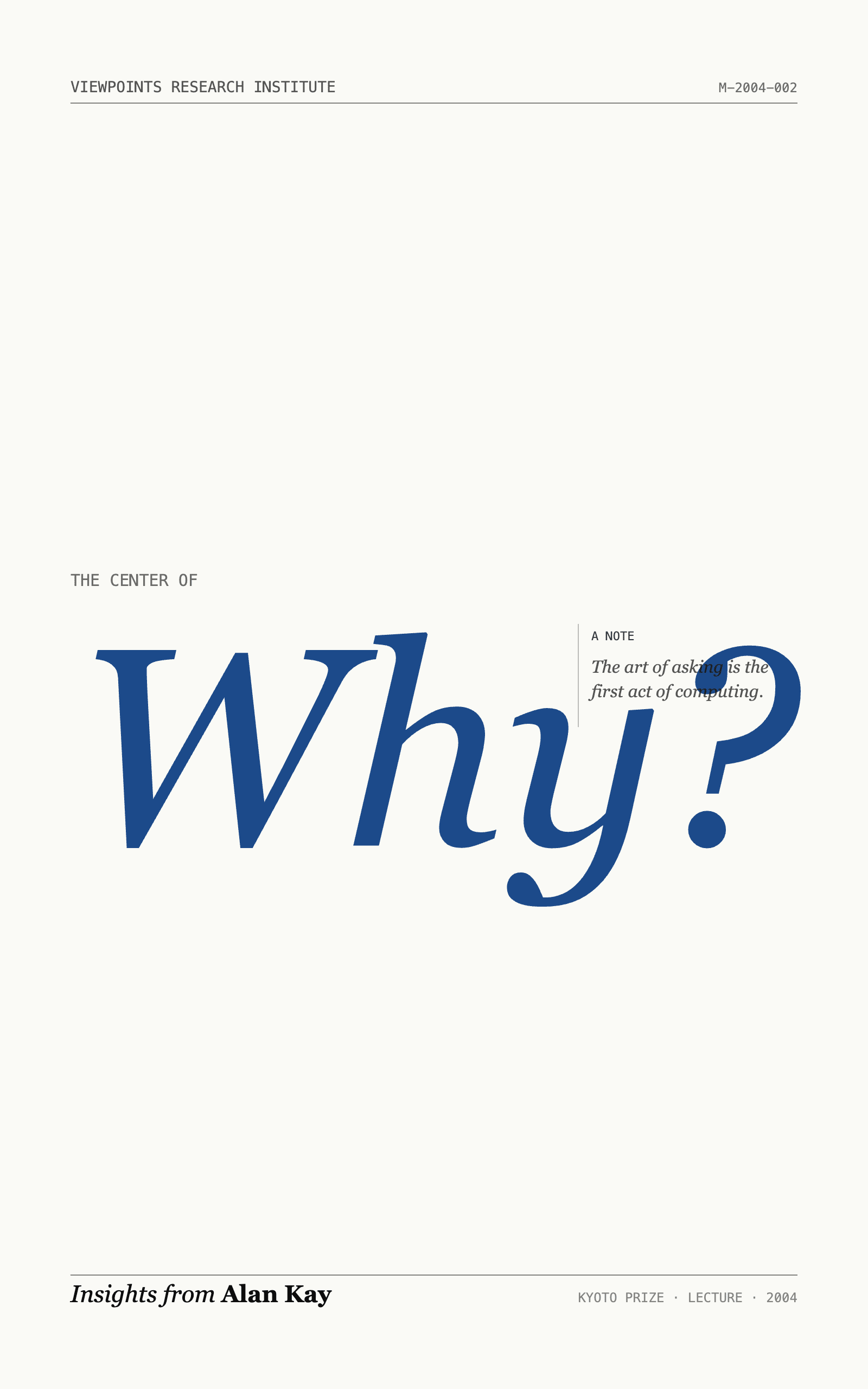
The Center of "Why?"
Alan Kay's profound insights on learning, art, science, and the aesthetic nature of computing. Explore how childhood curiosity, self-directed learning, and the intersection of art and science shape the minds of great innovators.
Read the Ebook →
|
|
SPONSORED BY SECRET BROKERAGE
Acquire sepet.com
A short, brandable 5-letter .com — premium real estate for a commerce, fintech, or consumer brand. Clean history, instantly pronounceable, globally deployable. Brokered by Secret Brokerage with escrow, confidentiality, and fast transfer.
|
|
Until next time,
Burak
Founder & Solo GP, Startupist Ventures Fund
|
|
Burak Büyükdemir
Founder & Solo GP, Startupist Ventures Fund · Startup Istanbul
Founder of Etohum & Startup Istanbul. Solo GP at Startupist Ventures. 26+ years building startup ecosystems across 170 countries.
|
“An object in possession seldom retains the same charm that it had in pursuit.”
— Pliny the Younger
Join 42,000+ founders who read every issue
No fluff. Just the lessons I wish someone had told me 20 years ago.
Fundraising frameworks
Founder psychology
Growth playbooks
Subscribe — It’s Free
Read by founders from YC, Techstars, 500 Global & 90+ countries. Unsubscribe anytime.
ALREADY SUBSCRIBED?
GO DEEPER.
Paid members get the full archive, every PDF I publish, a WhatsApp group where founders share war stories, and monthly meetups where we break things down live.
| ✓ Full post archive |
✓ Founder WhatsApp group |
| ✓ All PDFs & frameworks |
✓ Live meetups & webinars |
Unlock the Full Experience
About this newsletter: You are receiving this email because you subscribed to Burak’s Brainwaves. Every week, I share ideas on fundraising frameworks, founder psychology, and growth playbooks from 20+ years of investing in early-stage startups.
Update your subscription preferences: unsubscribe from all emails, or manage your subscriber profile.
Startup Istanbul · Istanbul, Turkey