Brainwaves by Burak Büyükdemir
Field notes from 26 years of investing in early-stage startups.
April 01, 2026
Salaries & Equity in Startups: The Fastest Way to Burn Your Runway
· · ·
I keep seeing the same pattern.
A founder starts a startup... and pays themselves like they were hired from a large corporation.
Then they hire employees the same way: corporate salary + equity on top, as if the startup is a "small version" of a big company.
This thinking quietly kills startups.
Not because founders or early employees should be broke.
But because a startup is not a normal company.
A startup is a search mission. You're searching for a repeatable business model. And during that search, runway is oxygen.
If you burn oxygen too fast, you don't "lose efficiency." You die.
The basic truth most people avoid
If you offer equity, you're not just offering upside.
You're also offering risk.
So the trade-off is simple:
- High salary → low risk → low equity (corporate world)
- Lower salary → higher risk → meaningful equity (early startup world)
If someone wants corporate salary and meaningful equity and low risk...
They don't want a startup.
They want a fantasy.
And fantasies are expensive.
The founder salary trap
Here's the most common mistake:
Founders pay themselves "market salary" because:
- "My friends make this much"
- "This is what I'm worth"
- "I can't take less"
But your startup doesn't pay you based on what you're "worth."
Your startup pays you based on what it can survive.
Early stage founder salary is not a reward. It's a runway decision.
And every extra dollar you pay yourself is taken from:
- Product iteration
- Customer learning
- Hiring the one key person you actually need
- Staying alive long enough to find PMF
You don't need to be broke.
But you do need to be realistic.
The employee salary trap
Another pattern:
Founders say: "This hire is strong. We must pay top-of-market."
Maybe.
But early-stage startups can't compete with corporates on salary. And they shouldn't try.
If someone requires a corporate package to join your early-stage startup, that's usually a sign:
- They're optimizing for safety
- They'll treat the startup like a job
- They'll leave the moment things get uncomfortable
And early-stage is always uncomfortable.
So the rule is simple:
If a person's mindset is corporate, don't hire them for a startup stage.
Let them work in a corporate.
It's not an insult. It's a mismatch.
What "healthy" looks like instead
Early-stage compensation should be built around survival + alignment.
1) Founders: pay for stability, not status
- Enough to function
- Enough to stay focused
- Not enough to shorten runway dramatically
2) Early employees: choose one primary lever
You can't max out all three:
- Salary
- Equity
- Job security
So decide what you're offering, clearly.
If you're offering meaningful equity:
- The salary will usually be below corporate
- The mission and learning must be real
- The upside must be honest, not hype
3) Make the trade-off explicit
The best early teams don't hide the math.
They say it clearly:
- "We can't pay corporate salary."
- "We can offer ownership."
- "This is high risk."
- "This is the stage."
- "If you want safety, don't join."
That clarity saves everyone time.
The thing founders don't want to hear
Salary is not "a later problem."
Salary is a day-1 problem because it controls runway.
If you don't solve it early, you enter the Death Valley:
- No PMF
- Slow learning
- High burn
- Constant fundraising panic
- Team stress
- Founder fatigue
And then you become one of the many "no-name" startups that quietly disappears.
I've seen startups die simply because founders insisted on market salaries. They burned runway fast, ran out of time, and then called it "bad luck."
It wasn't luck.
It was math.
The practical rule I give founders
You don't have to be broke.
But you should be prepared to live closer to "minimum viable life" than "corporate life" for a while.
That's the price of building something new.
And it applies to your first colleagues too.
If you're not willing to make that trade-off...
You don't want a startup.
You want a small company with a startup story.
Those are very different games.
· · ·
|
|
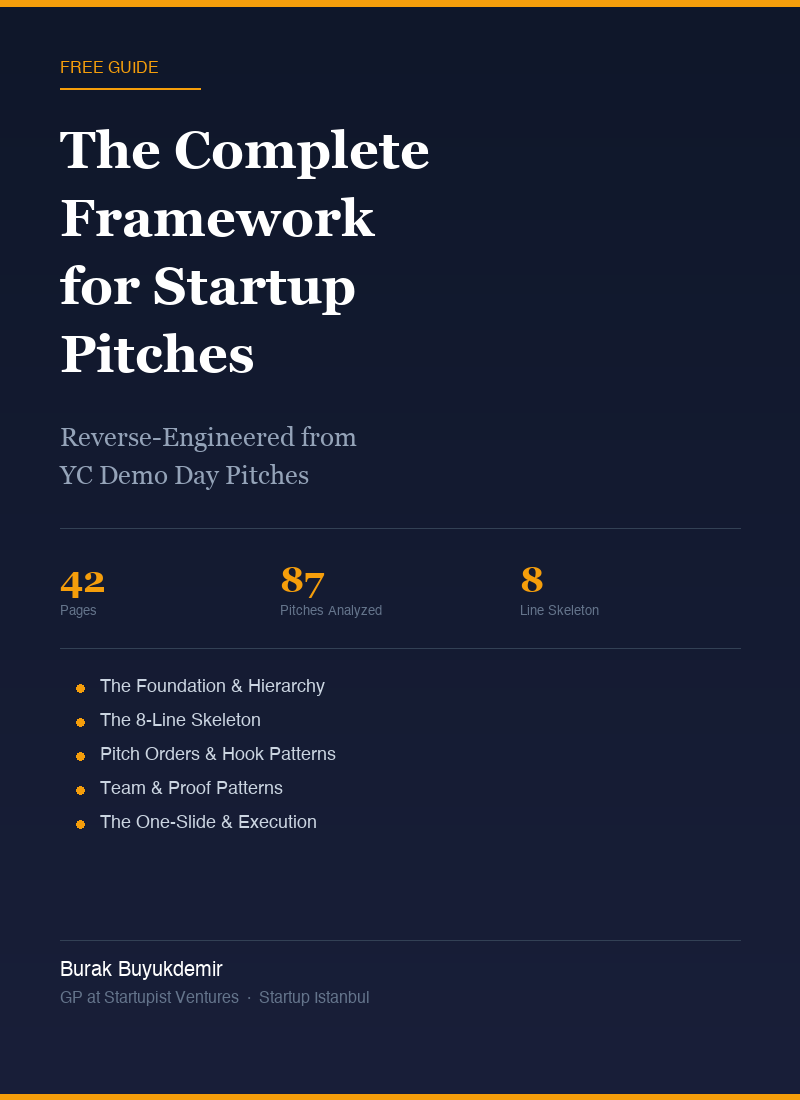
Free Guide — 42 Pages
The Complete Framework for Startup Pitches
Reverse-engineered from 87 YC Demo Day pitches. The 8-line skeleton that gets investors to lean in.
Download Free Guide →
|
Until next time,
Burak
Founder & Solo GP, Startupist Ventures Fund

|
|
Burak Büyükdemir
Founder & Solo GP, Startupist Ventures Fund · Startup Istanbul
Founder of Etohum & Startup Istanbul. Solo GP at Startupist Ventures. 26+ years building startup ecosystems across 170 countries.
|
“The Paradox of Building: you will think of a better way to do it after it's done.”
—
Join 42,000+ founders who read every issue
No fluff. Just the lessons I wish someone had told me 20 years ago.
Fundraising frameworks
Founder psychology
Growth playbooks
Subscribe — It’s Free
Read by founders from YC, Techstars, 500 Global & 90+ countries. Unsubscribe anytime.
ALREADY SUBSCRIBED?
GO DEEPER.
Paid members get the full archive, every PDF I publish, a WhatsApp group where founders share war stories, and monthly meetups where we break things down live.
| ✓ Full post archive |
✓ Founder WhatsApp group |
| ✓ All PDFs & frameworks |
✓ Live meetups & webinars |
Unlock the Full Experience
About this newsletter: You are receiving this email because you subscribed to Burak’s Brainwaves. Every week, I share ideas on fundraising frameworks, founder psychology, and growth playbooks from 20+ years of investing in early-stage startups.
Update your subscription preferences: unsubscribe from all emails, or manage your subscriber profile.
Startup Istanbul · Istanbul, Turkey